BoM 5: Boundless Mercy and Blessings, Likening the Scriptures

Tonight for Family Home Evening we tackled 2 Nephi 26. I was taken with the quote from Joseph Smith in one of the suggested study subtopics from Come, Follow Me for this week, that God is “more ‘boundless in his mercies and blessings, than we are ready to believe or receive’ (The Joseph Smith Papers, “History, 1838–1856, volume D-1,” p. 4 [addenda], josephsmithpapers.org).” My kids wanted to make Muddy Buddies as well so I considered if there was a ready way to liken the scriptures and use the treat-making as an object lesson. And I hit on something great!

We started by reading the quote from Joseph Smith and discussed what “boundless” means in context. We defined what it means to have boundaries and then talked about how Jesus has no limits on His love, mercy, or the blessings He wants to share with us. We read 2 Nephi 26:20-22 to lay the groundwork for our thinking about boundless love and mercy. I paraphrased a little, asking if the people described in those verses are making good choices or bad choices. Once we established that they’re making bad choices, we moved on to Nephi’s exclamations about the love of Jesus Christ for “the world” (all people in the world, I clarified) (see v. 23-33). I used our easel to summarize ways in which God is merciful as described by Nephi in the verses.
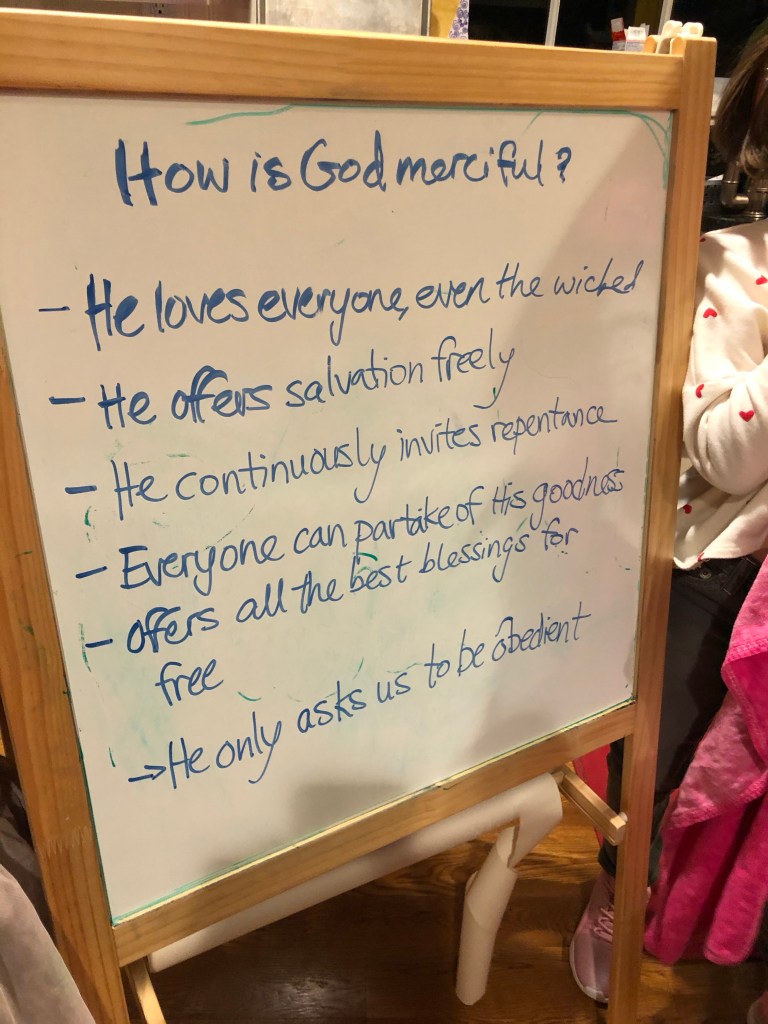
My narration helped them connect the fact that God loves everyone and wants to bless everyone, even if they’re making bad choices. Mercy comes into play as God blesses us even when by many standards we don’t seem to be deserving. My kids really got this as I asked whether they always make good choices. Does Jesus still love you when you make bad choices? I asked them. YES! They exclaimed.

I felt it was important to add a final note (like Nephi) about obedience. All God asks from us is to be obedient to His commandments. Nephi lists out many of them but I just wanted to touch on this essential component.

Then we began on the Muddy Buddies….
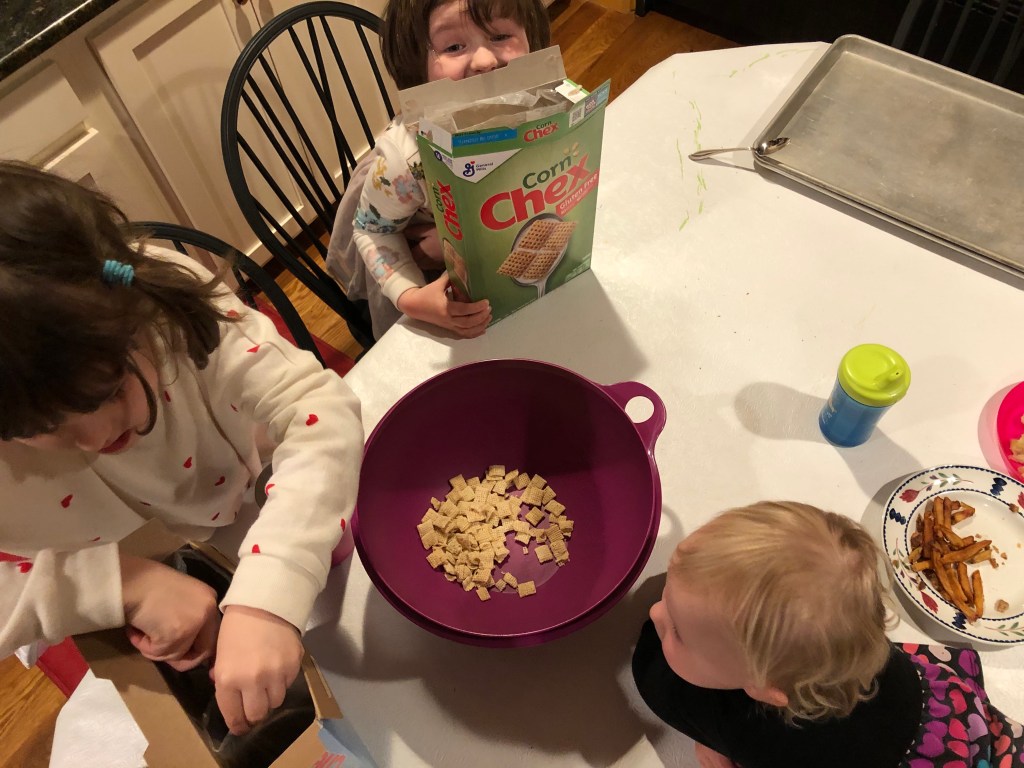
I explained that we’re kind of like the cereal—a little plain, tasty but nothing special. Jesus, however, wants us to be our best selves possible and offers us many different ways to achieve greatness (in my narration, “to become more delicious”). The kids took turns adding ingredients which I simultaneously wrote into our existing list, discussing with the kids as I went.
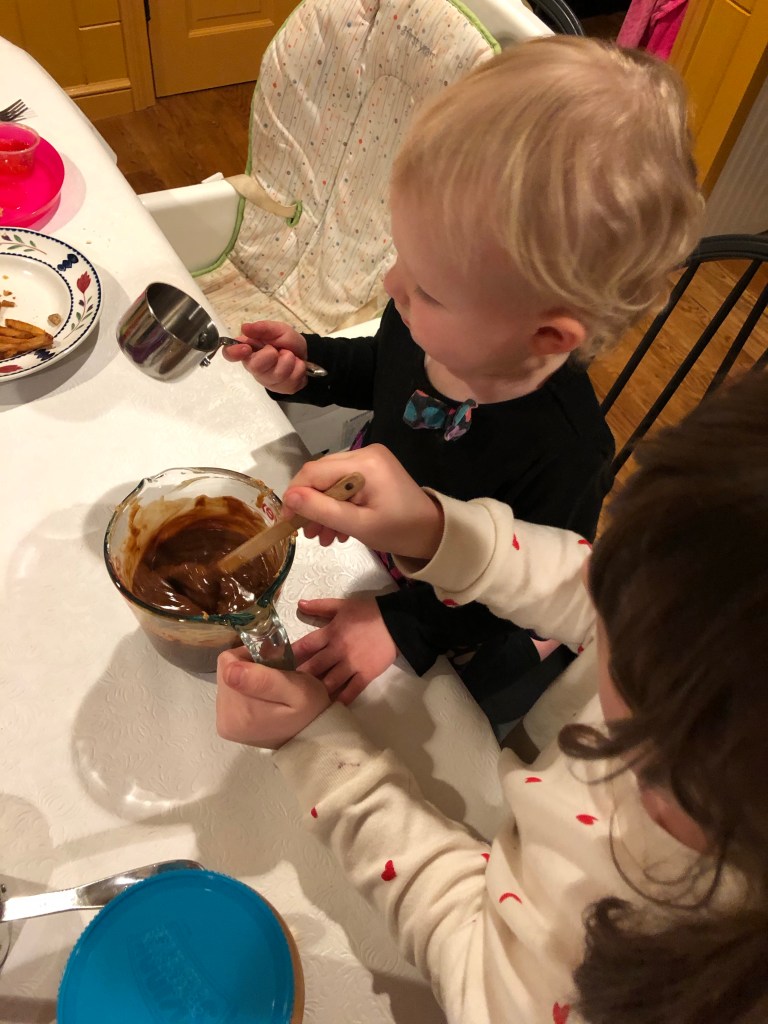
At one point I asked the kids what ingredient we should add next. My oldest suggested chocolate. I asked, “how do you know to add chocolate?” When she finally got to, “we need to follow the recipe,” I brought us back to obedience. God offers us unlimited mercy, continually inviting us to repent and come to Jesus to “buy milk and honey without price.” He freely offers magnificent blessings, but we have to follow His recipe as found in the scriptures and taught in His Restored Church to receive the greatest blessing of all—eternal life.
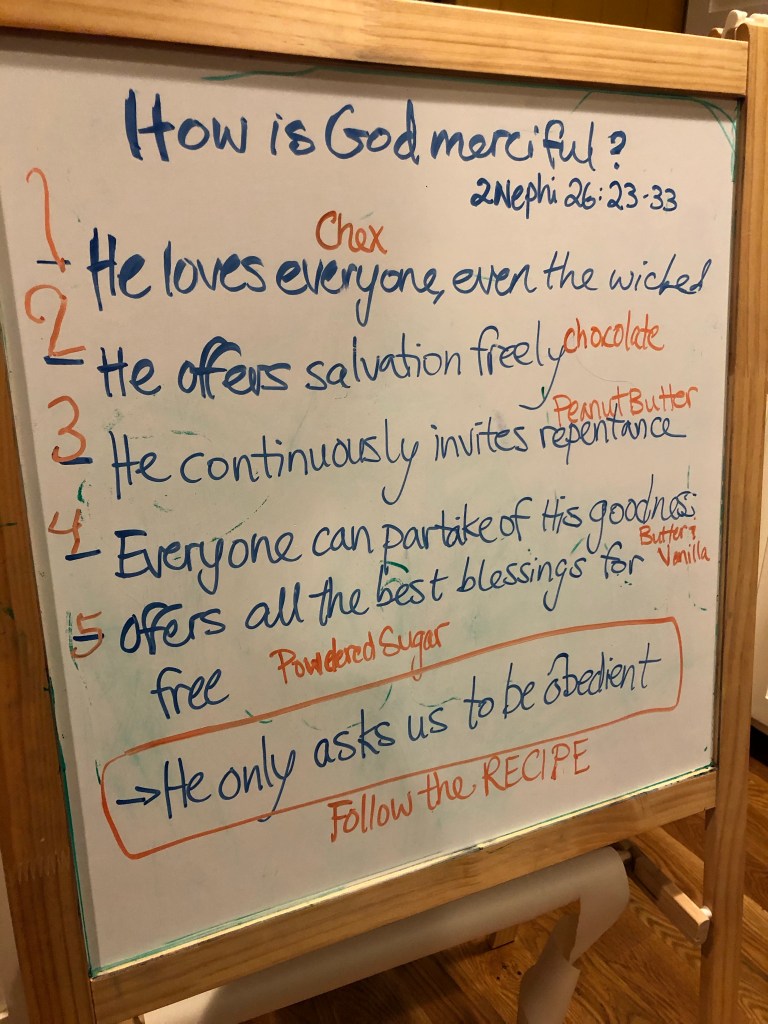
The girls were pretty quiet by the end—yes, they were eating Muddy Buddies hand over fist—but they were also attentive as I closed the lesson and testified of the importance of following God’s “recipe” for a happy and, eventually, eternal life. A basic understanding of mercy (we defined this as unlimited love for and desire to help/bless someone even if they’re making bad choices) seemed to click. I hope they caught a glimpse of the Savior’s boundless love for each of them.
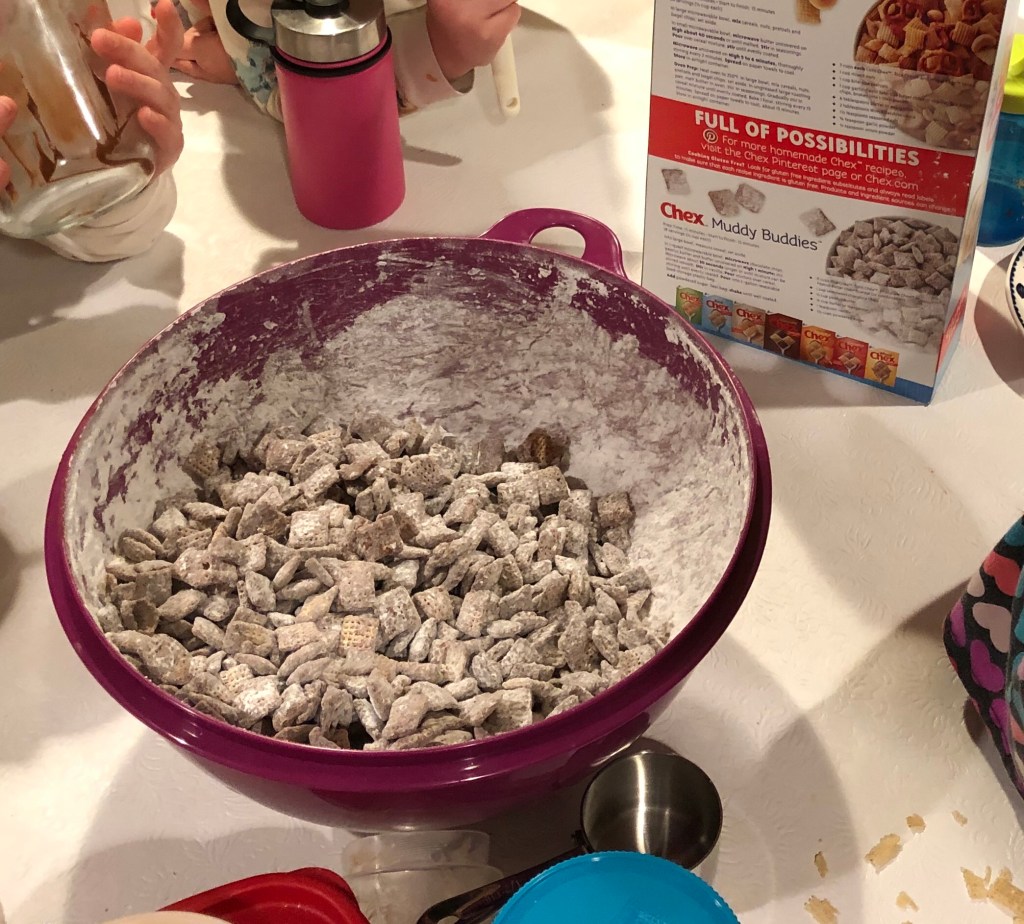
*No promotional considerations were made in writing this post. (It is simply hard to separate the cereal from its iconic recipe.)

BoM 4: Scattered…but Not Forgotten

Towards the end of 1 Nephi we see a really tender moment between Nephi and his older brothers. Lehi’s family has just arrived in the promised land, everyone is getting settled and Nephi resumes his record keeping and Gospel instruction. In the process of reciting details prophesied about the anticipated Messiah’s earthly appearance, Nephi mentions the scattering of Israel. This would be a poignant moment for Nephi and his brothers: they belong to Israel but God commanded their family to separate themselves from Israel and take a harrowing journey to a new land. They have become part of the prophesied “scattered Israel.”

As I read about Israel being scattered across the isles of the sea, I realized how that must have sounded to Lehi’s children—the isles of the sea were probably the most remote and desolate places they could imagine; it might be roughly equivalent to someone saying “Mars” or “Jupiter” today. Lehi’s family was now completely cut off from everything familiar and comfortable, with no chance of getting “home” back.

But Nephi’s message, and the tender moment, looks ahead to the future of their children and grandchildren down to our present day when God has promised that He will remember the isles of the sea and gather Israel again.

Nevertheless, when that day cometh, saith the prophet, that they no more turn aside their hearts against the Holy One of Israel, then will he remember the covenants which he made to their fathers. Yea, then will he remember the isles of the sea; yea, and all the people who are of the house of Israel, will I gather in, saith the Lord, according to the words of the prophet Zenos, from the four quarters of the earth.

1 Nephi 19:15-16, BoM

Nephi’s message of hope in covenants, Christ, and the love of God doesn’t seem to be lost on his brothers—they end up asking more questions in order to better understand the prophecies. (See 1 Nephi 22, BoM.)

How often do we feel separated from “home” or like we’ve been “scattered on the isles of the sea”? Sometimes we feel like heaven has gone quiet. Sometimes our own choices have led us off the covenant path and away from God. Some of us wonder if we could ever find a way back or if God will even be aware of us anymore. But His promise to the ancient Israelites holds true for all of God’s children. He does remember us. No matter how far we’ve gone we are always within God’s reach. “Are not five sparrows sold for two farthings, and not one of them is forgotten before God? But even the very hairs of your head are all numbered. Fear not therefore: ye are of more value than many sparrows” (Luke 12:6-7, NT).

No matter how distanced we feel from heaven, God is always able and willing to close the gap and gather us back to Him.

BoM 3: My Laman and Lemuel Moment…or Year

During last week’s Come, Follow Me reading I was startled as I heard my own voice while listening to the audio of 1 Nephi 17. Laman and Lemuel are complaining to Nephi about all their trials and hardships:

[Our father] hath led us out of the land of Jerusalem, and we have wandered in the wilderness for these many years; and our women have toiled, being big with child; and they have borne children in the wilderness and suffered all things, save it were death; and it would have been better that they had died before they came out of Jerusalem than to have suffered these afflictions.

Behold, these many years we have suffered in the wilderness, which time we might have enjoyed our possessions and the land of our inheritance; yea, and we might have been happy. (1 Nephi 17:20-21, BoM)

“We have suffered” echoed in my mind as I remembered the worst inner dialogue I have ever used in my life–and it was on my mission. “I hate this. I hate being a missionary. I feel so miserable. Why am I suffering so much? I can’t wait for this to be over. I enjoyed my other travel experiences so much more. I would be so much happier if I were anywhere else.” If that’s not self-defeating, I don’t know what is. These words repeated over and over in mind for months. In all fairness, I think I was dealt a rough hand on my mission, but I could have and should have found healthier ways of working through my challenges, misery, pain, and bitterness. (Luckily God taught me much and my inner dialogue doesn’t reflect the type of missionary I turned out to be.)

Part of my problem was that I had started my mission feeling like a Nephi. I knew the scriptures, I loved the Gospel, I was excited to teach people, I had made good choices my whole life, I had an education, and on and on. But God needed to teach me some important lessons and, as a result of a unique personality combined with some very difficult circumstances, I took these lessons very hard––in fact they were devastating. I felt like God had broken me down to nothing so I clung desperately to the accomplishments and qualities I had once used to pad my identity.

One of the most challenging things God taught me was in revealing a series of lies I had told myself about my character. As He exposed those lies, I fought the truth, desperately afraid of what would happen to me. But then, as I surrendered to His “stretching and ‘higher’ ways,” He helped me accept who I really was (both the good and the bad) and begin building a new character better founded in the teachings of Jesus Christ (see Maxwell, “Consecrate Thy Performance,” General Conference, April 2002.) For example, I had to accept that I was actually judgmental and self-righteous. As God built me back up, He taught me how to love people wherever they’re at and how to graciously acknowledge and admit my own weaknesses and shortcomings.

My “suffering in the wilderness” experience leaves me with sympathy for Laman and Lemuel. It is so easy to immediately label them as “the bad guys” in the narrative and every time I re-read the Book of Mormon I want to fall into that old pattern. But I am catching myself––I don’t want to judge them. I get why they were so upset! I left all my comforts, too, and wandered in the wilderness for a long time. Suffering is the worst! No one wants to suffer.

So, how do we solve the Laman and Lemuel dilemma? When we’re suffering in the wilderness, what do we do? For me, I’m going to change my inner dialogue and, instead of taking things so hard, I’m going to try and laugh more and be actively grateful for every blessing, the big and small. I’m going to submit more readily to God’s “stretching and higher ways” rather than cling to whatever it is God wants me to give up. Instead of being angry about what God is supposedly doing to me, I’m going to focus on what I can be doing to make life happier for others. Instead of rhapsodizing about the past, I’m going to look forward to the future and envision the happy, enjoyable times ahead. Instead of asking, why is this happening to me, I’m going to ask, what does God want me to learn from this experience? How is this experience going to change me in positive ways; how will it make me a better mother, wife, friend, disciple?